Categories
Blogs Rolling Mill

A wire rod mill is a high-speed rolling mill that converts reheated steel billets into coiled wire rod through a continuous hot-rolling process. In practice, it is one of the most important mills in long-product steel production because it sets the quality standard for downstream wire drawing, forming, and fabrication.

For steel producers, a well-designed wire rod mill is not just about output. It is about dimensional accuracy, surface quality, coil consistency, and the ability to serve different end-use grades reliably. That is why buyers, plant owners, and project teams often evaluate the entire line — from reheating to cooling — before choosing equipment or a supplier.

Direct Answer: A wire rod mill reheats billets, rolls them through a sequence of stands, guides the hot strand through a laying head, and cools it in controlled conditions before it is coiled and shipped for further processing. The output is typically supplied as coiled wire rod rather than as finished wire products.

What Is a Wire Rod Mill?

A wire rod mill is a rolling mill designed to produce wire rod from billets by hot rolling them through multiple passes in a continuous line. Modern mills are built for high speed, tight tolerances, and stable product quality — because the rod is usually rolled above 1,000°C and must still hold its shape and metallurgical properties as it travels through the line.

The output is typically wound into coils. Wire rod mills commonly produce coils weighing up to 2.5 tons, and the wire rod itself is generally supplied in small diameters for downstream use. To understand what a rolling mill is at its most fundamental level, it helps to first understand how different mill types serve different product families — wire rod being one of the most demanding.

Where It Fits in Steel Manufacturing

A wire rod mill sits after billet production and reheating. The billet is the input material, and the mill’s job is to reduce it progressively until it becomes a finished coiled rod. That rod is usually not the end product. It is a semi-finished feedstock for wire drawing, forging, and other secondary processing.

This is why the mill matters so much. If the rod leaves the line with poor surface finish, uneven cooling, or unstable dimensions, downstream processors will feel the impact immediately. Understanding the complete journey of steel through a rolling mill helps plant owners and buyers make more informed equipment and process decisions.

Wire Rod Mill Process: Step-by-Step

The wire rod mill process is continuous, fast, and tightly controlled. In a modern mill, the billet does not stop and start between every stage. Instead, it moves through roughing, intermediate, and finishing sections in one coordinated flow. Modern wire rod rolling may involve around 25 to 30 passes in a continuous mill.

Stage What Happens Why It Matters
Billet reheating Billets are heated uniformly before rolling Supports surface quality and stable deformation
Roughing mill Initial size reduction begins Prepares the billet for further rolling
Intermediate mill Further reduction and shape control Keeps the line stable at high speed
Finishing block Final dimensions are achieved Sets tolerance and product consistency
Pinch roll and laying head Guides the hot strand into coils Ensures clean coil formation
Controlled cooling Coil properties are adjusted during cooling Helps define microstructure and mechanical properties
Coiling and inspection Coil is checked, handled, and packed Confirms quality before dispatch

Step 1 — Billet Preparation and Reheating

The process begins with billet preparation. The billet must be reheated evenly before it enters the mill, because inconsistent temperature creates quality problems later in the line. Temperature control is especially important for surface condition, grain structure, and head-to-tail consistency.

In wire rod production, temperature management is not a minor detail. For smaller diameters, rolling time is longer, so the temperature drop from the head to the tail becomes more critical. The basics of reheating furnaces — from heating zones to temperature uniformity — directly determine how well the mill performs across the full rolling line.

Step 2 — Roughing Mill

The billet first enters the roughing section, where its cross-section is reduced, and its shape is prepared for the rest of the line. This stage starts the deformation process and sets up the metal for more precise reduction in the next stages.

In simple terms, roughing is the “first shaping” stage of the wire rod mill. The product is still far from its final size, but the line is already building the consistency needed for high-speed finishing.

Step 3 — Intermediate Mill

The intermediate stands reduce the section further and refine the shape before the strand reaches the finishing block. This stage is where speed synchronisation becomes critical, because the mill must keep tension, roll speed, and temperature under control across multiple stands.

A modern wire rod mill depends on stable coordination here. If the speed between stands is not managed properly, the rod can suffer from dimension variation, surface issues, or unstable coil formation later in the process. The hot rolling mill process demands continuous synchronisation — and wire rod mills push that requirement to its limit given the high operating speeds involved.

Step 4 — Finishing Block

The finishing block brings the rod to its final diameter and tolerance. This is one of the most defining parts of the wire rod mill, because it is where the line combines speed with precision. Modern wire rod mill systems are designed for high-speed production and typically incorporate reducing and sizing mills, advanced cooling technologies, and precise process control. This highlights the critical role of the finishing stage in achieving dimensional accuracy, surface quality, and consistent mechanical properties.

Step 5 — Pinch Roll and Laying Head

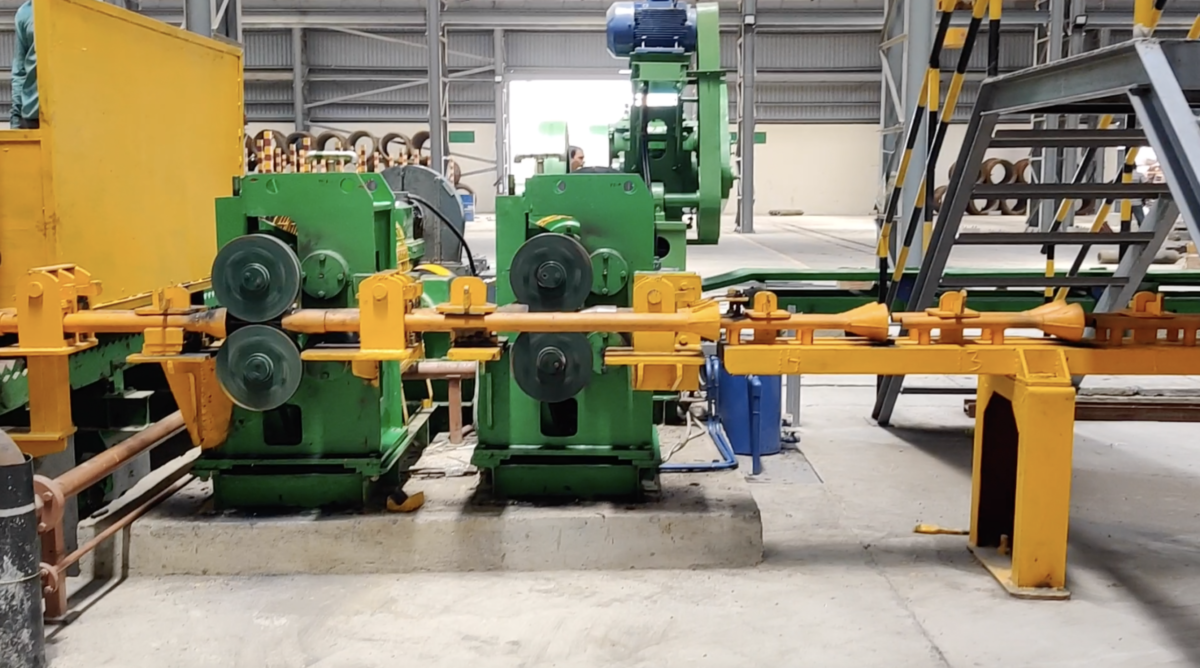
After the finishing stand, the rod is controlled by the pinch roll and the laying head. Their job is to guide the hot strand smoothly and form it into a consistent coil pattern as it leaves the mill. Positioned after the finishing block, the laying head controls rod tension and deposits the hot rod in a consistent coil pattern, supporting efficient cooling and coil formation.

Pinch rollers play a much more active role than many plant teams initially expect — they directly influence coil shape, tension consistency, and the way the rod enters the cooling conveyor. A poor coil pattern means handling problems, quality loss, and downtime. Good coil formation is one of the clearest signs of a well-run wire rod mill.

Step 6 — Controlled Cooling / Stelmor Cooling Conveyor

Cooling is not simply about reducing temperature. In a wire rod mill, controlled cooling helps shape the final microstructure and mechanical properties of the rod. Modern controlled cooling systems can accommodate different cooling rates for alloy, carbon, and stainless steel grades, helping manufacturers achieve the desired mechanical properties and microstructure.

That flexibility matters because different grades need different cooling rates. A line that can only cool one way is far less useful than one that can adapt to product grade, size, and performance requirements. The difference between hot rolling and cold rolling is particularly relevant here — because controlled cooling in a wire rod mill is what bridges the gap between the raw hot-rolled property and the final mechanical specification the customer needs.

Step 7 — Coiling, Inspection, and Packaging

Once cooled, the rod is inspected, handled, and prepared for dispatch. At this stage, coil shape, surface quality, and dimensional accuracy all matter because the product is about to move into downstream operations. Modern mills increasingly use automated systems to improve repeatability and section monitoring.

The value of a wire rod mill is not just that it produces metal in coil form. It produces consistent coils that downstream customers can process with less waste and fewer interruptions.

Main Components of a Wire Rod Mill

A wire rod mill is best understood as a system, not a single machine. Each component has a separate role, and all of them must work together.

  • The reheating furnace heats billets uniformly before rolling.
  • Roughing and intermediate stands progressively reduce section size and prepare the strand for finishing.
  • The finishing block delivers final dimensions at high speed.
  • Pinch roll and laying head guide the strand and lay it into clean coils.
  • A controlled cooling conveyor manages cooling rate and final rod properties.
  • Automation and control systems maintain speed, synchronisation, temperature, and section consistency across the line.

A strong wire rod mill depends heavily on automation. Reliable control systems are essential for improving size tolerances, mechanical properties, surface finish, tension control, and roll speed management. For complete wire rod and block mill equipment, Steefo supplies dedicated block mill systems for wire rod and TMT production that are built around these exact operational priorities.

What Comes Out of a Wire Rod Mill?

A wire rod mill produces hot-rolled steel rod that is collected and supplied in coil form. These coils are the form most buyers expect, because wire rod is usually moved to another plant for drawing, forging, or further forming.

In many mills, the rod falls within the small-diameter range used for long-product applications. Wire rod outputs are typically in the range of 5 mm to 12.5 mm in coil form, although actual product ranges depend on mill design and customer specifications.

It is essential to understand the difference between wire rod and finished wire products. Wire rod is the starting material; finished wire is the result of drawing and secondary processing. That is why wire rod quality must be high before it reaches downstream customers.

Uses of Wire Rod

Wire Drawing and Downstream Wire Products

The main use of wire rod is as feedstock for wire drawing units. During drawing, the rod is reduced to a smaller diameter and made into products suited for specific industrial or construction uses.

Common Applications

Wire rod is widely used to make products such as:

  • Fasteners
  • Springs
  • Wire ropes
  • Wire mesh
  • Barbed wire
  • Electrodes
  • Cable and reinforcement-related products
  • Automotive and hardware components

Industry Relevance

Different grades of wire rod serve different downstream industries. Wire rod grades can range from low carbon and mild steel to medium carbon, high carbon, and low-alloy steels — which explains why the same mill platform can support a wide variety of customer needs.

For engineering, automotive, construction, and manufacturing users, this flexibility is a major advantage. It allows the wire rod mill to serve multiple markets without changing the core production logic.

Why Process Control Matters in Wire Rod Mills

The quality of a wire rod mill product depends on the entire chain: reheating, rolling, laying, cooling, and automation. If one stage is inconsistent, the rest of the line cannot fully compensate. That is why modern mills are built around process reliability and operational flexibility.

Three factors matter most:

  • Temperature affects surface condition, rolling behaviour, and final structure.
  • Speed determines productivity and affects tension and coil formation.
  • Controlled cooling shapes the final properties and microstructure.

A practical example helps here. Wire rod coils can reach up to 2.5 tons and lengths up to 10 km, while rolling speed can go as high as 140 m/s in high-speed mills. Those figures show why control is so important: at that speed, small variations can quickly become quality issues.

Wire Rod Mill vs. Bar Mill

A wire rod mill is designed for continuous high-speed coil production. A bar mill, by contrast, is generally oriented toward straight long products. The difference sounds simple, but it changes mill layout, cooling design, finishing equipment, and handling systems.

Feature Wire Rod Mill Bar Mill
Product form Coils Straight bars
Rolling style High-speed continuous rolling Longer product handling
Key end equipment Laying head, cooling conveyor Straightening and bar handling systems
Main focus Coil quality, speed, consistency Straightness, length accuracy, and handling

This comparison helps plant teams understand why a wire rod mill is not just a smaller version of a bar mill. It is a different production concept built around a different output. For buyers evaluating how TMT bar rolling mills compare in cost and operational structure, the wire rod line adds an entirely different performance dimension.

Conclusion

A wire rod mill is a highly specialised rolling line that transforms billets into coiled wire rod through a continuous process of reheating, rolling, laying, cooling, and coiling. Its performance depends on how well each stage is controlled, because the final rod is only as strong as the process that produced it.

For manufacturers, the real value lies in consistency. A well-designed wire rod mill contributes to superior coil consistency, tighter dimensional accuracy, and smooth downstream processing for various steel grades.

Frequently Asked Questions (FAQs)

1. What is a wire rod mill used for?

A wire rod mill is used to convert heated steel billets into coiled wire rod for downstream drawing, forging, and fabrication.

2. What are the main parts of a wire rod mill?

The main parts are the reheating furnace, roughing stands, intermediate stands, finishing block, pinch roll, laying head, controlled cooling conveyor, and automation system.

3. Why is controlled cooling important?

Controlled cooling helps manage the rod’s microstructure and mechanical properties. It also allows the mill to adapt cooling rates to different grades.

4. What products are made from wire rod?

Wire rod is used to make fasteners, springs, wire ropes, mesh, barbed wire, electrodes, cable-related products, and automotive components.

5. Is wire rod a finished product?

No. Wire rod is usually a semi-finished product that is further drawn or processed before final use.

Looking for a Trusted Partner for Your Wire Rod Mill Project?

If you are planning a new wire rod mill project, upgrading an existing line, or evaluating turnkey solutions for long-product production, the right technology partner matters. The Steefo Group is a leading rolling mill manufacturer in India with manufacturing facilities in Changodar, Ahmedabad, and a strong focus on rolling mill design, manufacturing, and turnkey project execution.

As a trusted name for plant engineering and rolling mill projects in Ahmedabad and across the globe, Steefo Group supports clients with rolling mill plants, wire rod lines, and turnkey solutions for steel plants. Beyond supplying equipment, the company works closely with customers to address technical, operational, and project execution requirements.

Talk to us at +91 87589 98607 or email us at marketing@thesteefogroup.com to discuss your wire rod mill requirements and explore solutions designed for productivity, quality, and long-term performance.

Categories
Blogs Rolling Mill

In the fast-paced world of steel production, efficiency and precision are non-negotiable. One critical component ensuring seamless operations in hot rolling mills is the high-speed pinch roller. Designed to meet the demands of modern rolling mill machinery, these rollers play a pivotal role in improving production rates, maintaining material quality, and optimising energy consumption.

This article explores the key features of high-speed pinch rollers and how they drive efficiency and tension control in rolling mills.

What Are High-Speed Pinch Rollers?

Role in Steel Rolling Mills

High-speed pinch rollers are mechanical devices used in rolling mills to grip and control the movement of hot steel during the rolling process. Positioned strategically between different stages, these rollers ensure consistent material flow and precise tension control. Their primary function is to maintain the desired speed and alignment of the steel strip or bar, preventing slippage and ensuring uniform product quality.

The Mechanics and the Operational Significance

The core mechanism of pinch rollers involves two counter-rotating cylinders that apply controlled pressure to the steel material. These rollers are driven by advanced motor systems, which enable them to match the speed of the rolling mill. The operational significance of the rollers lies in their ability to regulate material tension, minimise energy loss, and reduce wear and tear on other machinery components. Maintaining consistent tension prevents defects such as wrinkles, warping, or uneven thickness in the finished steel products.

Key Features of High-Speed Pinch Rollers

Impact on Tension Control and Product Quality

Precision speed control is one of the most critical features of high-speed pinch rollers. By accurately regulating the speed of the steel material, these rollers ensure optimal tension control throughout the rolling process. Proper tension control minimises the risk of defects, such as cracks or deformities, ensuring a high-quality end product. Additionally, maintaining consistent speed improves the alignment of the material, reducing the likelihood of operational disruptions.

Technologies Enabling Precise Speed Regulation

Advanced speed control technologies, such as variable frequency drives (VFDs) and servo motors, empower pinch rollers to achieve unmatched precision. These technologies allow operators to adjust the rollers’ speed in real time, ensuring seamless synchronisation with other rolling mill machinery components. Sensors and feedback systems further enhance accuracy, enabling dynamic adjustments based on material properties and production requirements.

Durability and Material Strength

Construction Materials for High Performance in Extreme Temperatures

High-speed pinch rollers are designed to withstand the harsh conditions of steel rolling mills, where temperatures can exceed 1,000°C. The rollers are typically constructed from high-grade alloy steels, tungsten carbide, or other heat-resistant materials. These materials are chosen for their exceptional thermal stability, wear resistance, and ability to maintain structural integrity under extreme conditions.

Longevity and Maintenance Considerations

Durability is a key consideration for the machinery, as frequent downtime for maintenance can disrupt production schedules and increase operational costs. High-speed pinch rollers are engineered for longevity, with features such as corrosion-resistant coatings and optimised lubrication systems. Routine maintenance, including inspection and replacement of worn-out components, further extends their lifespan, ensuring reliable performance over time.

Advanced Tension Control

Mechanisms to Maintain Consistent Material Tension

Maintaining consistent tension is vital for achieving uniformity in steel products. It ensures that the material maintains its structural integrity during processing. Any deviation in tension can result in defects or damage to the steel, leading to waste and higher production costs.

High-speed pinch rollers are equipped with advanced tension control mechanisms, such as hydraulic or pneumatic actuators, which apply precise pressure to the material. These mechanisms ensure that the tension remains constant, even when the material thickness or speed varies.

Benefits of Uniform Tension in Steel Rolling Processes

Uniform tension improves product quality by preventing defects such as buckling or uneven thickness. It also enhances the efficiency of downstream processes, such as coiling or cutting, by ensuring the material remains properly aligned. Furthermore, consistent tension reduces wear and tear on other machinery components, contributing to the rolling mill system’s overall durability.

Energy Efficiency

Design Aspects that Reduce Energy Consumption

Energy efficiency is a critical factor in modern steel production, given the high energy demands of rolling mills. High-speed pinch rollers are designed with features that minimise energy consumption, such as optimised motor systems and lightweight construction materials. These design aspects reduce the energy required to drive the rollers, lowering operational costs and carbon footprint.

Contribution to Overall Energy Savings in Rolling Mills

Pinch rollers significantly reduce energy consumption at critical stages of the rolling process, contributing to overall energy savings. Their ability to maintain consistent speed and tension reduces the strain on other machinery components, leading to a more efficient production line. Additionally, energy-efficient rollers align with sustainability goals, helping steel manufacturers meet environmental regulations.

Automatic Adjustment Capabilities

How Pinch Rollers Adjust Automatically to Varying Material Thickness

Modern high-speed pinch rollers feature automatic adjustment capabilities, allowing them to adapt seamlessly to changes in material thickness or width. These adjustments are enabled by advanced control systems, which use sensors to detect material properties in real time. The rollers then modify their pressure and speed accordingly, ensuring optimal performance.

Enhancing Adaptability and Operational Flexibility

Automatic adjustment capabilities enhance pinch rollers’ adaptability, making them suitable for a wide range of steel rolling applications. This flexibility allows rolling mills to process various materials and dimensions without compromising efficiency or product quality. Moreover, automated systems reduce the need for manual intervention, improving operational safety and reducing labour costs.

Driving Efficiency in Steel Rolling Mills

Role of Pinch Rollers in Streamlining the Production Process

Pinch rollers are integral to streamlining production processes in steel rolling mills. By maintaining precise control over the speed and alignment of hot steel, they ensure that the material moves seamlessly between different stages of rolling. This reduces the chances of bottlenecks, ensuring uninterrupted operations and higher productivity.

Enhancing Throughput and Reducing Downtime

The advanced design of high-speed pinch rollers enables them to handle higher throughput without compromising performance. Their durability and reliability reduce the risk of unexpected breakdowns, minimising downtime and maintenance costs. Enhanced operational efficiency directly translates to improved production rates and reduced operational expenses.

Minimising Defects and Maximising Material Yield

One of the significant advantages of high-speed pinch rollers is their ability to minimise defects in steel products. By maintaining consistent tension and alignment, these rollers prevent issues such as warping, uneven thickness, or surface irregularities. Improved product quality leads to higher material yield, maximising the return on investment for steel manufacturers.

Technological Advancements in Pinch Roller Design

Cutting-Edge Innovations in Roller Design and Material Science

Recent advancements in roller design and material science have significantly enhanced the performance of high-speed pinch rollers. Innovations such as composite materials, improved heat resistance, and enhanced wear coatings ensure that the rollers can withstand the extreme conditions of hot steel rolling.

The Integration of Automation and Digital Controls

Automation and digital controls have revolutionised the functionality of pinch rollers. Features like real-time monitoring, predictive maintenance, and automated adjustments ensure optimal performance with minimal manual intervention. These technologies improve efficiency and enhance operational safety

Future Trends and Developments in Pinch Roller Technology

As the steel industry continues to evolve, future developments in pinch roller technology are likely to focus on further enhancing efficiency, durability, and sustainability. Innovations such as AI-driven controls, smarter materials, and energy-efficient designs will shape the next generation of rolling mill machinery.

Helpful FAQs

1. How can high-speed pinch rollers help reduce operational downtime in my mill?

Due to their durable construction, high-speed pinch rollers reduce operational downtime by minimising defects, ensuring consistent tension, and requiring less frequent maintenance.

2. What factors should I consider when selecting pinch rollers for different steel grades or thicknesses?

Consider factors such as material compatibility, temperature resistance, and the roller’s ability to handle varying thicknesses and speeds.

3. How do high-speed pinch rollers contribute to improving product quality and consistency in my mill?

High-speed pinch rollers prevent defects by maintaining precise tension and alignment, ensuring uniform quality and consistency in steel products.

4. What are the typical maintenance requirements for high-speed pinch rollers, and how do they affect long-term cost savings?

Routine maintenance includes inspections, lubrication, and replacing worn-out components. Proper maintenance enhances the rollers’ lifespan and reduces long-term costs.

5. Can high-speed pinch rollers integrate with existing rolling mill systems, or will I need to upgrade other equipment?

High-speed pinch rollers are designed to integrate seamlessly with most existing rolling mill systems. However, compatibility checks and minor upgrades may be required for optimal performance.

Enhance Your Rolling Mill’s Efficiency – Invest in High-Speed Pinch Rollers Today!

High-speed pinch rollers take your rolling mill operations to the next level. At The Steefo Group, our pinch rollers are designed to deliver precision, durability, and energy efficiency. They maintain consistent tension, reduce defects, and streamline production processes while ensuring superior product quality and increased material yield.

Stay ahead of the competition with our innovative pinch roller technology that integrates seamlessly with your existing rolling mill machinery. From automatic adjustments to real-time control systems, our pinch rollers adapt effortlessly to varying production demands, saving you time and operational costs.

Make a smart investment in pinch rollers and transform your production efficiency today. Contact us now at +91 98240 76873 or drop a mail at marketing@thesteefogroup.com
to learn more about our customised solutions tailored to your needs and give your rolling mill the competitive edge it deserves!

Categories
Blogs Rolling Mill


When we talk about pinch rollers and their utility and operation in the steel rolling mill, the first question that often comes to mind is what exactly is a pinch roller. Today, let us take the time to learn about them and how they are used. 

What is a Pinch Roller?

A pinch roller in a steel rolling mill is a vital element and machinery that facilitates hot rolling. They function on a horizontal cantilever structure with an air cylinder and a double roll device. This permits it to regulate the synchronous clam that moves up and down. Pinch rollers tend to have a certain opposition to the adhesion of different metals and also have an intrinsic property that allows lubrication. Their job is also to assist in eliminating coil rejection whose surface quality is not up to standard.  

The metallurgical aspects of the rolls help in delivering resistance to the bond and the abrasive wear. It also aids in improving and extending the length and providing equal wear to each pinch roll utilised in the process. Overall, pinch rollers are created to provide optimal performance and can satisfy the needs of hot steel strip coiling usage.

Types of Pinch Rollers Used in Steel Rolling Mills 

1. Billets Pinch Roller

Billet pinch rollers are placed right before the roughing mill. The job of the billet pinch roller is to hold onto the rolling stock. Doing so ensures that the rolling stock maintains a specific level of tension and stable forward transportation.

2. Segmentation Pinch Roller 

The segmentation pinch roller machine is positioned at the fold-out flying shear machine outlet. It can be adjusted to tilt and move the overall layout and the positioning of the upper cooling bed roller form. The arrangement is an oblique formation that includes pairs of four pinch rollers with alternating control pinch roll devices.

3. Pinch Brake Roller

The pinch brake roller is mostly utilised for the purpose of single-line rolling of the pinch and brake. It is also used before and after cutting flying feet. It is also responsible for holding back rolling stock to ensure that the rolling stock preserves a certain tension and stable transportation.

4. Swing Pinch Roller

The swing pinch roller is used for dual-motor drive form. In this case, both the lower and the upper rollers function with the assistance of AC motors via coupling.  Both motors maintain their speed by utilising the same inverter. The cylinder drives the upper roller, making it move up and down. This function, in turn, controls the clamping and unclamping fiction of the workpiece. 

5. Vertical Pinch Roller

The vertical pinch roller is generally used to roll the pinch in a single line. It is also employed before and after cutting flying feet. It is also responsible for controlling back rolling stock to guarantee that the rolling stock keeps a specific tension and stable transportation.

6. Tail Breakers

Tail breakers are put into position just behind the flying shear and before the cooling bed to lessen the momentum of TMT bars. It performs with AC and DC variable drives, and the pneumatic cylinder disconnects them. 

7. High-Speed Pinch Roller

High-Speed pinch roller is utilised at a different location in the rolling mill before and after the TMT quenching box. It is done to supply continuous tension to the bar. It is also developed with a spherical roller bearing.  

Why Depend on The Steefo Group for the Best Rolling Mill Equipment?

If you are searching for proper rolling mill equipment, look no further than The Steefo Group. We can equip you with everything your rolling mill will ever need.  We have been the leading and most favoured integrated rolling mill manufacturer for nearly four decades. The Government of India also acknowledges us as the Star Export House, and we adhere to our reputation. With over 100+ establishments, we are a prominent name worldwide and in the country. 

Understanding The Steefo Group’s Products 

You are getting assured quality when you select products from The Steefo group. You also get your hands on the most innovative and futuristic products that will help you transform the face of your business. We specialize in a wide range of projects, from complete turnkey projects to individual modular projects, that cater to the specific needs of your business. Our product range includes pinch rollers, TMT bar rolling mills, wire rod mills, mill stands, rolling mill gearboxes, reheating furnaces, and more.

Our emphasis on technology and innovation ensures that we deliver the most up-to-date products for your rolling mill after undergoing rigorous testing and quality checks.

To learn more about the Steefo Group and our products and how we can improve your productivity and profits, contact +91 98240 76873 or drop a mail at marketing@thesteefogroup.com

Categories
Blogs Rolling Mill


A pinch roller is a critical component in the rolling mill process. It is a vital intermediary between the raw material and the finished product. Its primary function is to facilitate the smooth movement of the metal or other materials being processed through the rollers. Doing so ensures consistent thickness and uniformity in the final output.

As such, selecting the right pinch roller is crucial for ensuring a rolling mill’s efficient and effective operation. The wrong choice of pinch roller can result in subpar product quality, increased downtime, and even equipment damage. Therefore, carefully considering the various factors involved in choosing the appropriate pinch roller is essential.

The importance of choosing the right pinch roller cannot be overstated. It is a crucial investment in the success of any rolling mill operation, and careful consideration should be given to all relevant factors to ensure the best possible outcomes.

Factors to Consider

When it comes to choosing the right pinch roller for a rolling mill, there are several key factors to consider. These factors include the material of the pinch roller, its size and diameter, the surface finish, and the heat treatment. Each of these factors plays a crucial role in determining the effectiveness and efficiency of the rolling mill process and can impact the quality of the finished product.

Material Used in a Pinch Roller

One of the most critical factors in selecting the right pinch roller for a rolling mill is the material from which it is made. Several different materials are used in pinch rollers, including SG, D2, H13 etc. Each material has its own unique advantages and disadvantages, and the selection of material depends on the specific requirements of the rolling mill application.

Size of a Pinch Roller

The size and diameter of the pinch roller also play a crucial role. It helps in determining the quality of the finished product. A pinch roller that is too small can result in uneven pressure distribution, creating inconsistencies in the material’s thickness and quality. Conversely, a pinch roller that is too large can cause excessive pressure, which can damage the material being rolled.

To determine the appropriate size and diameter of the pinch roller, manufacturers and operators need to consider the specific requirements of their rolling mill application. This includes the size and thickness of the material being rolled and the desired output.

Surface Finish of a Pinch Roller

The surface finish of the pinch roller can also impact the quality of the finished product. A rough or uneven surface finish can lead to imperfections in the rolled material, such as scratches or marks. A smooth surface finish, on the other hand, can result in a more consistent and uniform product.

Heat Treatment for a Pinch Roller

The heat treatment of pinch rollers can also impact their durability, reliability, and performance. Heat treatment is the process of subjecting the pinch roller to high temperatures to improve its strength and hardness.

Several different heat treatment options are available for pinch rollers, including 

  • Annealing
  • Quenching
  • Tempering

Annealing involves heating the pinch roller to a specific temperature and then slowly cooling it to relieve internal stress and improve its machinability. Quenching involves rapidly cooling the pinch roller to increase its hardness and toughness. Tempering involves reheating the pinch roller to a specific temperature and then cooling it to improve its ductility and toughness.

The selection of heat treatment depends on the specific requirements of the rolling mill application and the desired output. Manufacturers and operators need to carefully consider the benefits and drawbacks of each heat treatment option to determine the best choice for their application.

Additional Considerations

In addition to the factors discussed in the previous section, there are several other considerations to keep in mind when choosing the right pinch roller for your rolling mill. These include maintenance requirements and budget constraints.

Maintenance of the Pinch Roller 

Maintenance is an essential aspect of any piece of equipment, and pinch rollers are no exception. Proper maintenance and care can help extend the service life of the pinch roller, ensuring optimal performance and reducing the likelihood of breakdowns or failures. One of the most important aspects of maintenance is cleaning. Over time, debris, dirt, and other contaminants can build up on the surface of the pinch roller, reducing its effectiveness and potentially damaging the rolling mill. To prevent this, it is important to regularly clean the pinch roller and ensure that it is free from any debris. Lubrication is also an important aspect of maintenance. Proper lubrication can help reduce friction and wear, improving the performance and longevity of the pinch roller. It is important to use the right type of lubricant for the specific pinch roller and to follow the manufacturer’s recommended lubrication schedule.

Budget for a Pinch Roller 

Another consideration when choosing the right pinch roller is budget. The cost of the pinch roller can vary depending on the material, size, and other factors. It is important to balance quality and affordability when choosing the right pinch roller for your rolling mill. While selecting a cheaper pinch roller may be tempting, it is vital to consider the long-term costs and potential drawbacks. A lower-quality pinch roller may be prone to wear and damage, requiring frequent replacement and costing more in the long run. On the other hand, investing in a high-quality pinch roller may cost more upfront but can ultimately save money by reducing the need for frequent replacements and repairs.

Why Rely on The Steefo Group for the Best Pinch Rollers?

When choosing a pinch roller for your rolling mill, it is essential to consider all these factors and work with a reputable manufacturer. The Steefo Group, offers a wide range of pinch rollers designed for use in rolling mills of all sizes and types. Our experienced team can help you choose the right pinch roller, considering the material, size, surface finish, and heat treatment. We also offer comprehensive maintenance and support services to ensure your pinch roller always operates at its best.

Our projects and products undergo rigorous testing and quality checks to supply the best-in-class products. Our focus on technology and innovation also provides you with the most up-to-date products for your rolling mill.

To learn more about the Steefo Group and their products and how they can improve your productivity and profits, contact +91 98240 76873 or drop a mail at marketing@thesteefogroup.com.

Categories
Blogs Rolling Mill


To manage the fast-paced nature of steel rolling mills, you need superior quality products that can support your production line. If you are looking for such premium quality, the only name that one should rely on is The Steefo Group. Our futuristic and innovative modular products can transform and aid all your growing business needs. This will allow you to obtain more clients due to your new and improved business performance. Steefo Industries also provides high-quality products that pass through several quality assurance checkpoints to ensure seamless performance. Our products and manufacturing process goes through constant up-gradation and improvement to guarantee that our clients only receive the best of the best.

Now, let us give you a glimpse at our vast product line.

Reheating Furnaces

Reheating Furnaces are essential for hot rolling mills. They help in converting the Billets into rolling temperatures and making them suitable for deformation and further use. The Steefo Group’s reheating furnaces stand apart from the rest because it ensures several benefits that are necessary for improved performance, such as

  • Consistent Thermal Level and Thermal Homogeneity
  • Mark Elimination
  • Combustion Automation
  • High-Quality Refractory Material Installation

Rolling Mill Gearbox

As the number one rolling mill manufacturers in India, we also create rolling mill gearboxes. A gearbox is a housing that contains numerous open gear sets. The housing comprises shafts and bearings and contains lubricants, and protects the component from other conditions. The job of the gearbox is to increase or decrease the speed and torque of the drive unit depending on the requirement. Our gearboxes are available in several load capacities and have multiple speed ratios. The Steefo Group ensures that our rolling mill gearboxes have the best-

  • Dimensional Accuracy
  • Reliability
  • Optimum Performance

Mill Stands

Mill Stands are an essential part of rolling mills. They can do quick roll change and complete automation to create numerous products, namely, wire rods, universals, channels, beams and more. The Mill Stand produced by the Steefo Group has several purposes, such as the hot rolling of wire rods, TMT bars, strip mill and much more. To work with the demand of our clients, we ensure that our mill stands can be upgraded and customized. Fibre Bearing and Anti Friction Roller bearing upgrades in our conventional stands are some.

Shears

The Steefo Group has the expertise in creating some of the best shears among all rolling mill manufacturers. The Shearing machine is an integral part of the entire hot rolling process. These are installed to cut the tail end and the length. This step is taken to fit the cooling bed and the commercial length of the TMT bars. Our shears have the Steefo guarantee of being of superior build and performance-driven.

Pinch Rollers

A Pinch Roller created by the Steefo Group is essential when working with hot rolling and strip steel mills. Pinch Rollers operate horizontal cantilever structures that require an air cylinder and double roll device, which allows the up and down synchronous roll clamp. A pinch roller aids in removing coil rejection because of poor surface quality. In general, pinch rollers are designed to provide superior performance and can meet the expectation and needs of the hot steel strip coiling application.

Loopers

If searching for the best loopers, you should rely on the ones produced by the best rolling mill manufacturers in India. Our Loopers are required at the finishing mill area for a tension-free rolling process and to ensure accurate section tolerance is achieved. To improve production capacity by reducing miss rolls, installing loopers is critical. Looper also can be installed in the inter-stand position to decrease the tension variation by a simple angle adjustment, improving bar threading and product quality.

Quenching System

The Quenching System supplied by the Steefo Group is trusted by rolling mills in India and worldwide. A quenching system, also known as the TMT box, is installed after the final finishing stands on the mill train to provide the rebars with the thermal treatment necessary to create the product. The Quenching system provided by us also cleanses the surface via scrubbing. These are some of the characteristics our superior quality quenching system offers:

  • Consistent ring formation
  • Uniform tensile strength along the length of the bar
  • Motorized valves
  • Corrosion-free
  • Time-efficient
  • High-quality design
  • Powerful construction
  • Closed frame to adapt the forces in the sizing press
  • It can be operated under extreme conditions

Automatic Cooling Beds

Our Automatic Cooling Beds are necessary to cool down TMT bars by using uniform air cooling and are also used to transport it in a phased manner to the discharged side. These beds also provide alignment when they are transferred onto the roller table to the finishing section.

Packing Beds – Tying & Bundling

The Steefo Group creates superior quality and advanced packing beds for steel rolling manufacturing. Packing beds are necessary for tying and bundling rebars. These packing beds are critical, enhance productivity, and improve plant function.

Roller Table – Conveyor

We manufacture some of the most efficient range of Roller conveyors or roller tables necessary for rolling mills. These roller tables transfer a billet to the charge furnace, then transfer it from the furnace to the roughing mill and cooling bed. It is then used to shift the product to the shearing machine, which is cut depending on the desired length.

Why Choose Products From the Best Rolling Mill Manufacturers

When you select products from The Steefo group, you are getting guaranteed quality. You also get your hands on the most innovative and futuristic products that will help you transform the face of your business.

Our projects and products also undergo rigorous testing and quality checks to supply the best-in-class products. Our priority on technology and innovation also provides you with the most up-to-date products for your rolling mill.

To learn more about the Steefo Group and their products and how they can improve your productivity and profits, contact +91 98240 76873 or drop a mail at marketing@thesteefogroup.com.

Categories
Blogs Rolling Mill

When you talk about the best steel rolling mill manufacturer, what is the one name that comes to your mind? The Steefo Group, right? The Steefo Group is acknowledged as one of the most established companies leading the way in steel rolling mill manufacturing since 1976. Steefo Industries has built its credibility and reputation through its superior quality and design and has even been recognised by the government of India as the Star Export House. Our company has earned that title with over 100+ establishments worldwide, turning itself into a domestic and international name. 

In the world of steel rolling mills, Steefo Industries redefines the term quality and calibre because of its ability to execute any project. Including some of the most mind-blowing turnkey projects at record time while maintaining that Steefo quality. 

Well, the reason behind The Steefo Industies’ astronomical success is because of multiple factors. But at our core, our highly trained engineers, advanced machinery and cutting-edge manufacturing facilities create an unshakable foundation. 

How is The Steefo Group Different?

Let us discuss what allows The Steefo Industries to stand apart from the crowd and brand itself as your reliable steel forming partner. 

Quality

Steefo Industries has earned a worldwide reputation for its superior quality. The focus on quality is given the highest priority, and the team takes extra effort to ensure that. To us, our premium quality is the highest value addition to our products. The products are created to meet even the most stringent norms and standards globally. The standard is maintained throughout the manufacturing process, from the concept to commissioning. 

To guarantee that the customer has the highest quality products, the quality assurance team performs regular quality checks and testing at every stage of the manufacturing process. The raw materials are thoroughly examined and undergo metallurgical and other quality tests. 

Research and Development

Steefo Industries takes innovation to the next level. Everyone in the team believes there is always space for improvement and innovation. The research and development team focuses on developing R&D and design capabilities and technical development. Steefo Industries is one of the few manufacturers utilising the most advanced technology to satisfy customers’ demands. 

Innovation

Change is an opportunity. We use that opportunity to innovate and create. Steefo Industries understands that and boosts any chance to innovate. To the company, innovation is more than simply developing new products and technology. The aim is to allow design engineers to use their knowledge and rationale to dig deep and resolve issues that seem uncertain. 

Our team learns how to adapt to new changes in the process, management, business systems, and more to ensure customer satisfaction and growth. 

When you partner with The Steefo Industries, you invest in not only superior grade products but also invest in our workforce that delivers the best results.  

What Are We Known For? 

Turnkey Solutions 

Steefo Industries is known worldwide for the turnkey solution that we provide. The team offers technological responsibility aiding customers during the total project life cycle from concept to commissioning. This includes rolling mills as well as integrated steel plants. 

Steefo Industries provides the required plant equipment and guarantees execution.

The Steefo Group provides turnkey solutions in the areas mentioned below: 

  • Greenfield / Brownfield integrated mini steel plant
  • TMT bar rolling mill
  • Structural rolling mill
  • Wire rod mill
  • Customised solutions

Products 

Steefo Industries also excels in single modular products required to grow your business and allow customers to improve their business performance and productivity. To operate a steel plant, you need various products for efficient functioning as a whole unit. The products provided by Steefo Industries are not only of superior quality but also pass through several quality checks and global standards. These are just some of the products provided by Steefo Industries:

  • Reheating Furnaces 
  • Rolling Mill Gearbox
  • Mill Stands 
  • Shears
  • Pinch Rollers
  • Loopers
  • Quenching System 
  • Automatic Cooling Beds 
  • Packing Beds
  • Roller Tables 

And more 

Why Choose The Steefo Group?

Why choose Steefo Industries? The question should rather be, why not?

The Steefo Group has reached this level of success due to its relentless drive toward excellence and an uncompromising attitude towards quality. We are continuously growing and endeavouring to improve our current products and solutions; therefore, we have transformed into the leading innovation in the world of rolling mills. 

You get high-quality products and constant support from our team of professionals when you work with us. Join the world of success. To learn more, call us at +91 98240 76873 or drop us a mail at marketing@thesteefogroup.com